
Buy Low Price From Here Now
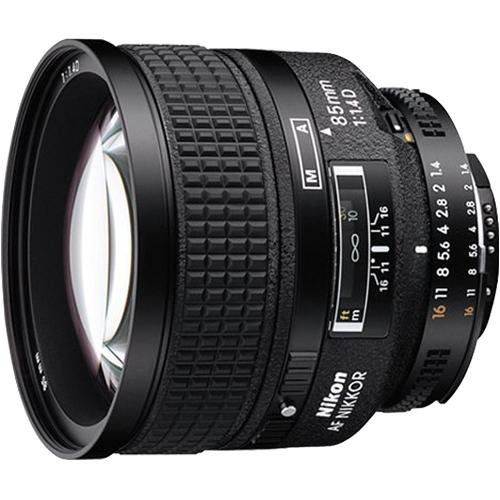
85mm lens for Nikon SLR cameras
Readmore
Technical Details
- 85mm focal length is considered the optimal choice for portrait work using a 35mm SLR camera- F/1.4
- D-Series for Nikon mount cameras
See more technical details

By Steven Janes (Germany)
If you are looking at this lens, you will probably already know what it is. Within the limitations of it's design, it is perfect and a real classic.
Having said that, it is what it is. Obviously it is a Prime Lens, not a zoom, so you have to want that. And also clearly it is an old design - no AF-S, no VR. But, you already knew that didn't you?
Bokeh, especially wide open, is wonderful... This is the reason people buy this lens.
Build quality could not be better. All metal construction. You could use it to hammer nails if the need arose. It also feels great in the hand (I have it mounted on a D700 with battery grip).
Only slight irritation (not worth deducting a star for) is the lens hood. It is a screw in design, not a quick bayonnet mount and can not be reversed for storage. When mounted it is slighly tricky to get the lens cap securely on (I had it falling off a few times). However, it is a good, solid metal hood so will also give some physical protection.
By Glenn Carpenter (Golden, Colorado)
I didn't expect this lens to be so astonishingly good.
I've read all the reviews and all the tests, and I've used my share of older Nikon AF and AF-D lenses, and I expected a performance from this lens along the lines of what I'd experienced with other, similar lenses - just with the addition of the legendary bokeh that everybody seems to buy it for and the giant fast aperture.
Instead what I got is a lens that exceeds its spec sheet, exceeds the performance implied by every formal test I've ever seen of it, and exceeds nearly every expectation I had for it.
Here's why:
Any lens will tend to lose acuity as larger apertures are used. This is due to spherical aberration and occurs to very different degrees in different lenses, but occurs to some degree in every lens. Tests of this lens show this loss of acuity to a similar degree to that which occurs in its smaller f/1.8 sibling, which I found to be mediocre wide open, and to most of Nikon's older AF and AF-D primes, the performance capabilities of which I'm also familiar with and not always particularly impressed by.
Yet while those other lenses are indeed diminished in terms of image quality as their wide-open aperture is approached, the 85/1.4 doesn't seem to lose a thing in terms of the visual impact of its images no matter how wide it's opened up. Even wide-full-open at f/1.4, this lens gives stunning images with excellent sharpness, excellent contrast, and beautiful colors that leap right out of the image in full three-dimensional glory.
The reason, I suspect, has to do with the fact that the perception of sharpness in an image is not at all the same thing as pure optical acuity. Acuity is the element effectively measured by performance tests, which look at the loss of contrast on a tiny scale barely resolvable by a digital sensor. Quite different is what our eyes perceive when we look at an image. The "snap" we find striking when looking at a stunning photo has to do with color and contrast on a somewhat larger scale, and also with other factors in the image as a whole, such as the contrast between in-focus and out-of-focus parts of the image. Under close inspection at full magnification, it is clear that this lens, like any other, loses acuity at very large apertures. The overall color and contrast, though, the snap and pop that makes images look vibrant, alive and three-dimensional, does not diminish. That is extraordinary in an f/1.4 lens. It means that I can take a photograph of a colorful, detailed subject with this lens at f/1.4, and with another excellent lens at f/5.6, and the image made by this lens will have at least as much of those qualities, even viewed with moderate magnification, as the f/5.6 image will have. That is the reason this lens deserves its legendary reputation.
Of course, that f/1.4 image will also have the beautiful bokeh that this lens is famous for, and it will have a degree of de-focus (not the same as bokeh, which is the QUALITY of the de-focus) that can make the background meld into a soft blur of color mere inches from the plane of perfect focus. That of course is also what this lens is legendary for. Many lenses can create de-focus, though: wider, slower lenses can do it close-up, and longer, slower lenses can do it at similar distances - and some, to my eyes at least, have bokeh that is just as nice as the 85/1.4. What makes this lens remarkable is the combination of those qualities: excellent quality of bokeh, degree of blur controllable all the way to extreme at f/1.4, and a rendering of the in-focus part of the image that is just superb, and that loses not one whit of perceived quality even at wide-open aperture. That is a combination that will let you make magic.
It is not perfect. This lens' biggest optical flaw is something that is most commonly called purple fringing. This is a chromatic aberration that occurs in out-of-focus contrast transitions and can also, I believe, be called longitudinal chromatic aberration. It occurs because different wavelengths of light are focused slightly differently as they pass through the various lens elements, and it is very noticeable in certain types of images if you look closely. The lens is also susceptible to flare, so it's important to take care to shade the front element, if possible, when shooting into backlit scenes. These qualities do affect the usability of the lens to a degree, but this lens is a rather specialized tool, and knowing when to use it, and how to use it properly, should be considered a reasonable requirement for anybody who wishes to benefit from its extraordinary capabilities.
Perfection is one way to greatness, and there are lenses out there that come close to perfection without being extraordinary in any particular way. Some of those lenses are deserving of five-star ratings. This lens does the exact opposite, being extraordinary despite significant imperfections, and I give it five stars as well. It is utterly unmatched, probably by a wide margin, and probably at any price, at doing what it does well. Regardless of its relatively minor imperfections it is, with a capital "G," one of the Great Nikon lenses.
Notes:
- This lens has a near complete lack of any of the latest Nikon buzzword tech: there are no ED elements and no aspherical elements, it does not have Nikon's close-ratio correction (CRC) floating-element design, and of course it does not have AF-S focusing. It could probably benefit from all of those things, the first two of which would no doubt help with its issues with chromatic aberration. It does, however, have Nikon's excellent "SIC" lens coating, which I suspect is responsible, along with a good overall optical design, for its excellent performance in terms of contrast and color rendition, especially wide-open. Having fewer elements than the complex zooms no doubt helps as well, as each air/glass and glass/glass interface causes some attenuation in lens performance. The complex zooms with multiple ED and aspheric elements seem to need those tricks, while this lens gets by without them.
- Compared to the 85mm f/1.8D: In my humble opinion, there is no comparison. This lens suffers from none of the 1.8 lens' relative lack of contrast in comparison to Nikon's newer lenses: in fact just the opposite - it seems, if it's possible, even contrastier and more vibrant in its rendition of colors than even the best of them. That alone gives its images a subtle, but noticeable, bump in quality compared to the f/1.8. This lens' wide-aperture shots don't lose the punch that the 1.8D's do. And while I didn't personally find the 1.8D's bokeh to be particularly nice, this 1.4D does certainly live up to its reputation in that area, being equal to the very best. Even if you never shot this lens wider than f/1.8 it would be twice the lens the 85/1.8 is. These differences are modest but not small, and they show up in every image. The difference between greatness and competence is often subtle. Here, to my eyes, it is nevertheless very clear.
- This lens uses 77mm filters, which is very handy for most Nikon users as that has been the standard pro filter size for twenty years or so now. To get the most out of this lens you will really need to invest in at least one high-quality neutral density filter of 2-3 stops. This will allow you to shoot the lens in brighter conditions and still benefit from its control over depth of field. I have two 2-stop ND filters and sometimes use both of them together, which the lens handles well, although focusing can become difficult. Another good investment might be a very high-grade, multi-coated protective filter, which can be helpful in diminishing the flare that this lens can suffer from. I recommend Hoya's excellent "HD" filters, the best I've used at helping to control flare.
- Focus is very accurate on my sample. That is a very important consideration for a lens with such a narrow wide-open depth of field, and I've had more than one fast lens whose wide open performance was effectively ruined by inconsistent focus. While this is not an AF-S lens and consequently lacks the subtle, incremental ability to track motion that AF-S lenses tend to have, it is extremely good for still shots even at f/1.4.
By Ro
I have been shooting with this lens for 5 months now and find this is my new favorite lens to shoot with. The 85mm is a little bit too long for me at one point or another when trying to frame my kid in tight area. I have been doing a lot of foot works since I got this lens. Just be prepare to do some exercises when you decided to purchase one if not shooting in a portrait studio.
One small detail that I had noticed though is that the len is "Made In Japan" but the lens' cap is "Made In Thailand." Could this be right? Nikon uses lens' cap from Thailand instead of manufacturing their own in order to save money?
By nnsuch (USA)
I've had my eye on this lens for some time, but was very hesitant to spend the money on it. I bought it a couple of months ago and have used it almost exclusively on my D90 since then. This is a great lens, and I know it was the right lens for me to add to my photo gear right now.
I agree with previous reviewers, there are 2 main reasons to buy this lens. First, if you shoot in low light conditions this lens performs incredibly well. The other day I was at my kids' school taking some musical photos for the yearbook. The auditorium manager was out for the day, so we couldn't turn on the stage lights. We only used the house lights and a very small amount of background stage lights, so it was very dark and I wasn't feeling optimistic about getting some decent shots. But wide open, the lens was capable of producing sharp, clear, decently exposed images.
The other main reason to buy this lens is the bokeh, of course. It is very smooth and beautiful. However, this lens does take some practice and skill when shooting wide open. It is a very sharp lens even at 1.4, but there is no room for error with focus since the depth of field is so narrow.
One other thing that I really like about this lens is it's size and weight. It's hefty and well-built, but isn't too heavy or cumbersome on my D90. I feel perfectly comfortable walking around with this lens. Sometimes people suggest getting a 70-200mm before or instead of the 85mm, but for me this lens is a much better fit and more versatile. Yes, the 70-200mm also has great bokeh, has a more versatile range, and can be better for indoor sports. But it's size and weight are a major negative me. I wouldn't use a 70-200mm for casual portraits, or as a walk around lens, or everyday casual shots. In my opinion, the 85mm is great in all of those situations.
There are some negatives to this lens - it is a little too long on a DX body at times and there are some chromatic aberration and flare issues when shooting wide open.
If you are thinking about getting this lens, do your homework and figure out of this is a right fit for you. For me, it is a very versatile lens and a great performer and I am completely satisfied with it.
By Enche Tjin (Philadelphia, PA)
Nikkor AF 85mm f/1.4 has been hailed as legendary lens for Nikon DSLR or film camera. I think it is because of its unique characteristic but also its age. This lens has been around for thirteen years.
Image Quality and characteristic
Mounted in Nikon full frame camera D700, the lens is sharp at maximum aperture of f/1.4D, which is excellent. Stopped down to f/2.8, the lens become very sharp. But extreme sharpness is not what this lens is made for. It is primarily made for its ability in low light condition, and its ability to create a beautiful out of focus effect in background or foreground.
Because of those characteristic and its fixed focal length, this lens is ideal for portrait. It is also good for candid portraiture such as in wedding. For Nikon pro wedding shooters, this lens is one of must have lens.
Unfortunately, this lens suffers a bit from purple fringing in high contrast area (see sample pic below), it is also susceptible to flare, but not as bad as other lenses.
Auto Focus operation
Because Nikon 85mm f/1.4D does not have built-in motor focus like modern lenses (AF-S) lens, it relies on camera body to focus. It speed will also depend on the camera body. The more higher-end model such as Nikon D700, D3 or D3X will focus faster than the entry-level camera.
When mounted in Nikon D700, the lens focus very fast. Unfortunately entry level user such as Nikon D40, D40X and D60 only can use manual focus because the camera body doesn't have the capability to focus AF lenses. This lens also create some noise when focusing because lack of Silent Wave Motor.
In sport games such as basketball, the lens has difficulty in continuous tracking. It fails to lock on the object properly resulting in many blur image. I don't recommend it for sports.
Build Quality
Built quality of this lens is awesome, it is average in size and weight and very nice to handle. The focus ring is smooth. Closest focusing is 85cm, make it not very ideal for macro / close-up photography.
It will come with "metal" lens hood. Unfortunately the lens hood it screw in type and you can't reverse it for more compact storage. In spite of that, the lens hood is fully metal, so it is better than regular plastic type and a lot more durable.
Nikkor 85mm f/1.4D vso 85mm f/1.8D
Compare to f/1.8D version, This lens is 2.5 times more expensive, the cheaper lens is not as sharp as f/1.4D in its maximum aperture of f/1.8. At f/2.8, the sharpness is almost equal. The build quality is also a lot worse than the f/1.4D. But the 85mm f/1.8 is more compact and portable.
In Conclusion
You might want to get this lens because of several reasons:
* You frequently shoot at extremely low light condition which f/1.4D is often needed
* You are concern about artistic, especially smooth background blur.
* You are looking for the sharpest lens from edge to edge of the image. (The lens is designed to be sharp in the center "focus" and soft in the corner).
Don't buy this lens for indoor sports, it is better to get either f/2.8 telephoto zoom lens or lighting equipment.
check out www.radiantlite.com for other reviews
Images Product
Buy Nikon 85mm f/1.4D AF Nikkor Lens for Nikon Digital SLR Cameras Now

No comments:
Post a Comment